

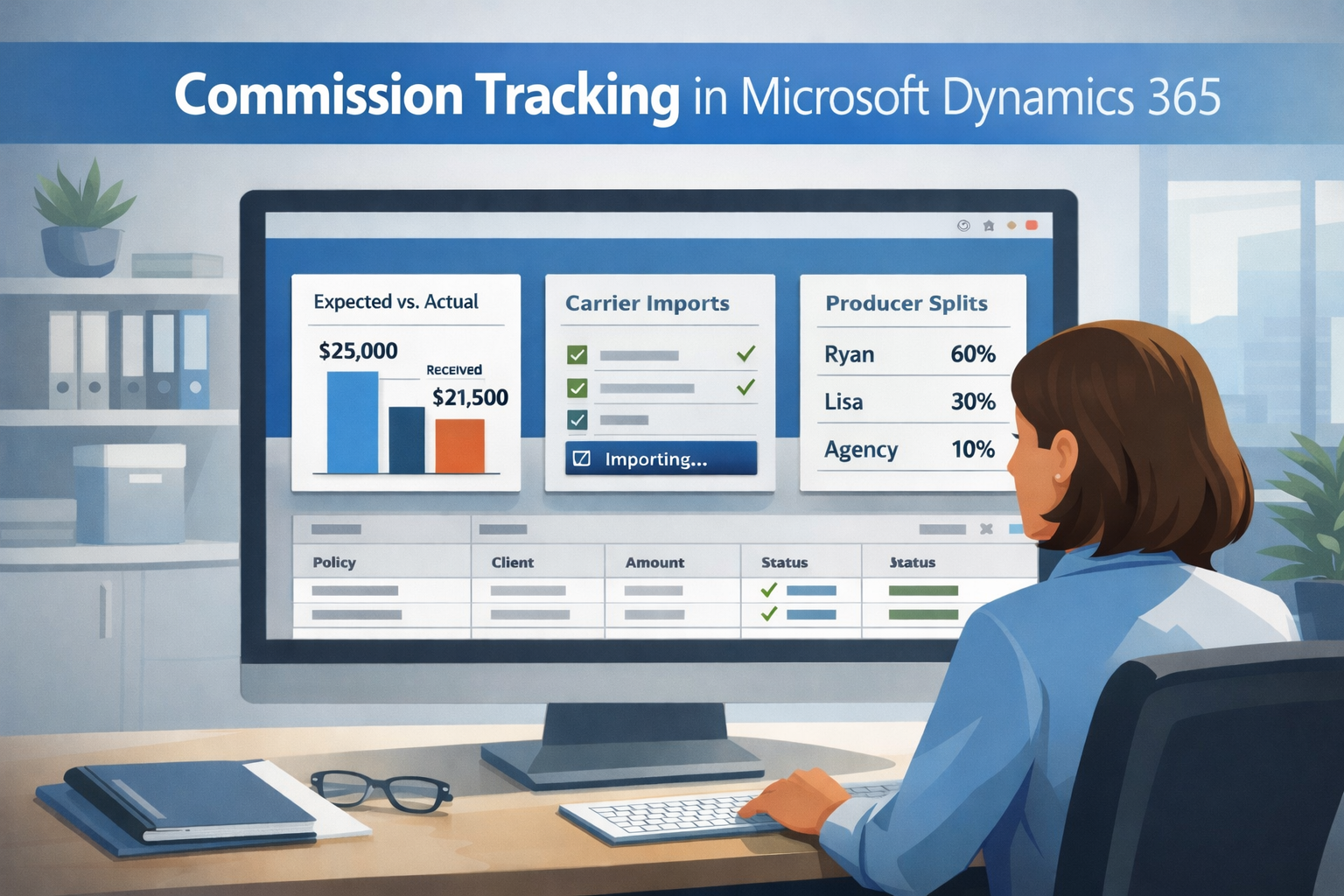
Commission tracking breaks down when schedules, splits, and carrier statements live across spreadsheets and inboxes. When an agency centralizes the commission tracking function into Dynamics 365—finance, producers, and operations work from one trusted source.
Commission Tracking for Benefits Brokers Works Best When It Lives Inside Your CRM
For health insurance brokers, commission tracking has a way of becoming more painful every year. Carrier payment schedules vary. Renewals don’t align. Producer splits evolve. And when the source of truth is scattered across spreadsheets, emails, and one-off reports, the work turns into constant reconciliation nightmare.
A better approach is to manage commissions inside Microsoft Dynamics 365, where policy, producer, and client data already lives. When commission schedules, projections, and payments are tracked in the CRM—not alongside it—teams gain accuracy, visibility, and confidence across the agency.
Why commission tracking breaks down as agencies grow
Most agencies don’t start with “commission chaos.” It creeps in as the book of business expands:
- More carrier files and formats
- More split variations by producer, line, or account
- More exceptions, corrections, bonuses, and mid-year changes
- More pressure to answer “what are we owed?” quickly and correctly
Once commissions live outside the CRM, reporting becomes inconsistent—and the real cost is time, trust, and momentum.
What changes when commissions are centralized in Dynamics 365
Centralizing commission tracking means your team can pull up commission history the same way they pull up a client record: quickly, consistently, and without guesswork.
In BenefitsBridge for Dynamics 365, you can store and view commission details like:
- Policy effective dates
- Premium amounts and payment frequency
- Commission type/structure
- Historical payments and adjustments
Instead of hunting through old emails or versioned spreadsheets, BenefitsBridge is the CRM and agency management single source of truth – the place people go to get answers.
Standardize commission calculations once, then apply them everywhere
One of the biggest wins is repeatability.
Rather than rebuilding formulas in spreadsheets for every carrier or scenario, you define commission rules once and apply them consistently—whether your model is flat rate, per-employee-per-month, or graded schedules based on premium, covered lives, or duration.
When policies change, the system recalculates—so you’re not doing manual “cleanup work” just to keep numbers current.
Automate producer splits to reduce friction and rebuild trust
Producers want transparency. Finance wants consistency. Leadership wants fewer surprises.
A CRM-first approach allows agencies to apply splits automatically using predefined rules, such as:
- Fixed split percentages between producer and agency
- Reusable split templates for recurring payments
- Consistent handling of incoming payments and outgoing distributions
This doesn’t just save time—it reduces disputes and strengthens confidence in reporting.
Track expected vs. actual commissions (and see gaps early)
When commissions are managed systematically, you can track projected payments side-by-side with received payments across the life of a policy.
That means:
- You can see what should arrive (and when)
- You can spot underpayments faster
- Adjustments like bonuses/corrections can be applied cleanly
- Lump-sum carrier payments can be allocated across multiple policies accurately
This is the difference between “closing the month” and actually managing commissions proactively.
Reduce manual work with carrier statement imports
Carrier commission statements are often the most time-consuming part—especially when formats vary and matching is manual.
A streamlined workflow supports importing carrier statements, automatically matching payments to the right policies, and isolating unmatched items for review. The result: less data entry, fewer errors, and more time back for service and operations.
The bigger point: commissions impact more than accounting
Reliable commission tracking strengthens the entire agency:
- Better policy management and renewals
- Faster responses to client questions
- Higher producer satisfaction and trust in reporting
When the numbers are trusted and accessible, teams can stop reconciling and start operating.
Key takeaways
- Commission tracking gets harder when data lives across spreadsheets and inboxes.
- Centralizing commissions inside Dynamics 365 improves visibility, consistency, and confidence.
- Automated calculations, splits, and imports reduce errors and busywork.
- Commissions aren’t just finance—they’re an operational foundation for insurance brokers.
Why It Matters
Our customers consistently experience the flexibility and impact of Microsoft Dynamics 365 and CRM solutions built upon the Microsoft Power Platform, streamlining Modern health insurance benefits brokers must act as both benefits subject matter experts and strategic advisors. By integrating AI and CRM tools, agencies can:
✅ Unify client engagement in one platform
✅ Improve service delivery and efficiency
✅ Drive insight-led sales strategies
✅ Lay the groundwork for scalable growth
BenefitsBridge: Built for Employee Benefits Brokers
At ForgeXRM, we’ve created BenefitsBridge, an industry-specific CRM solution for benefits brokers, powered by the Microsoft Power Platform. BenefitsBridge connects your client data, automates policy renewals, and helps uncover new opportunities—all within the Microsoft ecosystem your team already knows.
With BenefitsBridge, you can:
- Automate renewals and plan comparisons
- Consolidate client and carrier data
- Track all service activity in one place
- Empower your team with mobile-ready, AI-enhanced tools
BenefitsBridge closes the gap between traditional AMS systems and modern CRM capabilities—helping agencies engage clients more strategically and operate more efficiently. You can also learn more about BenefitsBridge on Microsoft Marketplace.
Read the original article on the CRM Software Blog for additional insights and examples: How Do Health Insurance Brokers Streamline Commission Tracking with Dynamics 365?