
Individual Coverage Health Reimbursement Arrangements, better known as ICHRAs, are becoming a more prominent part of the employee benefits conversation.
That does not necessarily mean traditional group health insurance is going away. Group plans remain an effective and familiar option for many employers, employees, and benefits brokers. ICHRA simply introduces another model—one that may be appropriate for certain employers based on their workforce, geography, coverage objectives, and financial priorities.
For benefits brokers, the important question is not whether every employer will eventually adopt ICHRA. It is whether brokers have the knowledge, processes, and technology to support clients that decide to explore it.
What Changes Under an ICHRA Model?
ICHRA became available for plan years beginning in 2020. Subject to applicable requirements, it allows an employer to reimburse employees for individual health insurance premiums and other eligible medical expenses rather than offering those employees a traditional group health plan. Employees then select qualifying individual coverage based on the options available to them.
From a broker’s perspective, the employer relationship does not disappear. The employer still needs guidance on plan design, employee classes, contribution strategies, affordability, communication, and administration.
What may change is the amount of individual-level information the broker needs to manage.
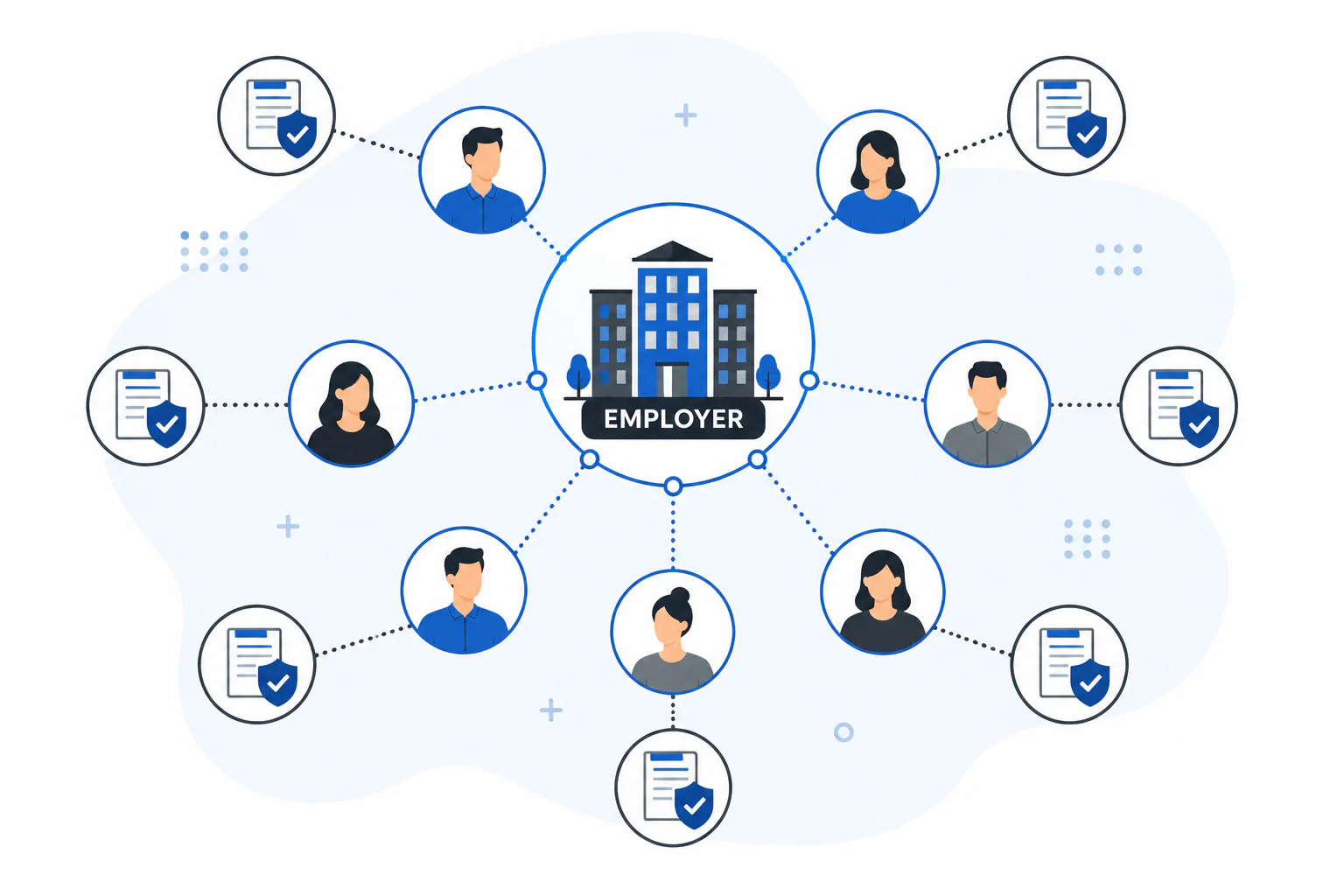
A traditional group benefits CRM is generally organized around the employer, its group policies, carrier relationships, renewal dates, contacts, and plan participants. Under an ICHRA model, brokers may also need visibility into individual policies, household or dependent relationships, enrollment status, effective dates, reimbursement amounts, carrier selections, and individual renewal activity.
That introduces a different operational model—not necessarily a better or worse one, but one that can be more data-intensive.
From Group-Level Service to Individual-Level Visibility
Consider an employer with 200 eligible employees.
With a traditional group plan, the brokerage may primarily manage one employer account, a defined set of plan options, and a small number of HR or benefits contacts. The broker’s team still supports employees, but much of the policy information is managed collectively at the group level.
With ICHRA, those employees could potentially select coverage from different carriers and plans. Depending on the broker’s service model, the brokerage may need to track and support many more individual policy relationships beneath the employer account.
That could affect:
- Enrollment and onboarding workflows
- Policy and household data management
- Renewal reminders and follow-up activities
- Employee communications
- Carrier and plan tracking
- Individual commission reconciliation
- Medicare eligibility and other life-stage events
The underlying CRM must preserve the employer-level relationship while giving the broker an organized view of each participating employee and policy.
ICHRA Does Not Have to Be an Either-Or Decision
Some benefits professionals view ICHRA as an important alternative to traditional group insurance. Others remain skeptical about its fit, employee experience, administrative requirements, or long-term market impact.
Both perspectives deserve consideration.
Industry reporting indicates that ICHRA adoption is growing among both small and larger employers. However, the HRA Council’s 2025 data also found that only 17% of participating employers had transitioned from traditional group insurance. Most employers in its data set had not previously offered coverage, suggesting that ICHRA growth may expand access to employer-sponsored benefits as well as compete with some group plans.
For brokers, this creates an opportunity to remain a trusted advisor across multiple benefit models. The objective should not be to promote ICHRA in every situation. It should be to help employers evaluate the available options and implement the model that best fits their needs.
What We Are Exploring for BenefitsBridge
BenefitsBridge is currently designed around the operational needs of group benefits brokers, including account management, policy tracking, renewals, commissions, workflows, and client service.
As ICHRA receives more attention, we are researching whether BenefitsBridge should also support brokers that need to manage individual policies within an employer-sponsored relationship.
A potential ICHRA capability could provide a structured way to connect an employer with its participating employees, household members, reimbursement information, individual policies, carriers, renewal dates, and related service activities.
We are still evaluating the market appetite, broker requirements, and appropriate scope. This is product research—not a product announcement or a commitment to a specific release.
Our goal is to understand how brokers want to serve this market before determining what technology they need from us.
Preparing for More Than One Benefits Model
ICHRA may become an important part of the employee benefits market, remain concentrated within particular employer segments, or evolve alongside traditional group insurance. The outcome will likely vary by employer size, geography, workforce composition, and individual market conditions.
Regardless of its ultimate market share, ICHRA highlights a broader technology question: Can a benefits brokerage manage both group-level and individual-level relationships without creating disconnected systems and manual processes?
That is the question we are exploring as we consider the future of BenefitsBridge.
Benefits brokers evaluating ICHRA—or deciding how it fits alongside their existing group benefits business—are invited to share the workflows, data, and service challenges they believe a CRM platform should address.
Sources
• IRS: Health Reimbursement Arrangements (HRAs) • HRA Council: 2025 Growth Trends Report